fps
FPS TCP Flow Shape Experiment
This page records an exploratory pcap analysis of the visible
fps_client <-> fps_server TCP flow before and after Zero-RTT upgrade. It is
not a regression gate and it is not a censorship-evasion proof. The goal is to
measure whether the current beta implementation changes packet-size and timing
distributions in a way that is visible below TLS.
Scenario
The experiment used the current Linux TUN VPN adapter over the generic FPS covert datagram transport, in a local Docker/TUN topology:
- one
fps_server; - one
fps_client; - one debug HTTPS/WSS
fps_carrierorigin; - one persistent WSS carrier client;
- bidirectional UDP
iperf3traffic over the FPS TUN lease, which the adapter mapped to opaque FPS datagrams before transmission.
The carrier generator produced continuous WSS echo traffic. Zero-RTT upgrade was
intentionally delayed with --pre-upgrade-records 60 so the capture had a small
pre-upgrade window and a longer post-upgrade window. The pcap was captured on
the concrete Docker bridge interface for the FPS TCP link. Capturing Docker
traffic on Linux any can duplicate or reorder packets enough to confuse TCP
reassembly and TLS record checks.
Reproduction command:
FPS_DOCKER_SUDO=1 tools/docker_pcap_flow_experiment.py \
  --image fps:local \
  --duration 30 \
  --bandwidth 2M \
  --iperf-bidir \
  --length 1200 \
  --carrier-bps 300000 \
  --carrier-frame-rate 30 \
  --pre-upgrade-records 60
Readable plots were generated from the analyzer CSV/JSON with an optional local Python venv:
python3 -m venv .venv
.venv/bin/python -m pip install matplotlib pandas numpy
.venv/bin/python tools/plot_pcap_flow.py \
  --packets-csv captures/<project>/flow-packets.csv \
  --summary-json captures/<project>/flow-summary.json \
  --out-prefix captures/<project>/readable-flow
The plotting dependencies are developer-only analysis tools. They are not FPS runtime, Docker image, CMake or CI dependencies.
Wire-Shape Check
The captured FPS link still parsed as TLS records in both directions:
total TLS records: 14697
client -> server Application Data records: 7346
server -> client Application Data records: 7347
content types observed: ChangeCipherSpec, Handshake, ApplicationData
This confirms only syntactic TLS record framing. It does not say that the flow’s packet sizes and timing still match the carrier’s original distribution.
Plots
Measured Result
The bidirectional UDP probe completed without packet loss:
| Direction | UDP target | Observed UDP throughput | Lost packets |
|---|---|---|---|
| client to server | 2 Mbit/s | about 2.00 Mbit/s | 0 |
| server to client | 2 Mbit/s | about 2.00 Mbit/s | 0 |
Visible FPS TCP-link packet statistics:
| Phase | Duration | Packets | IP throughput | IP size p50 | IP size p95 | inter-packet p50 | inter-packet p95 |
|---|---|---|---|---|---|---|---|
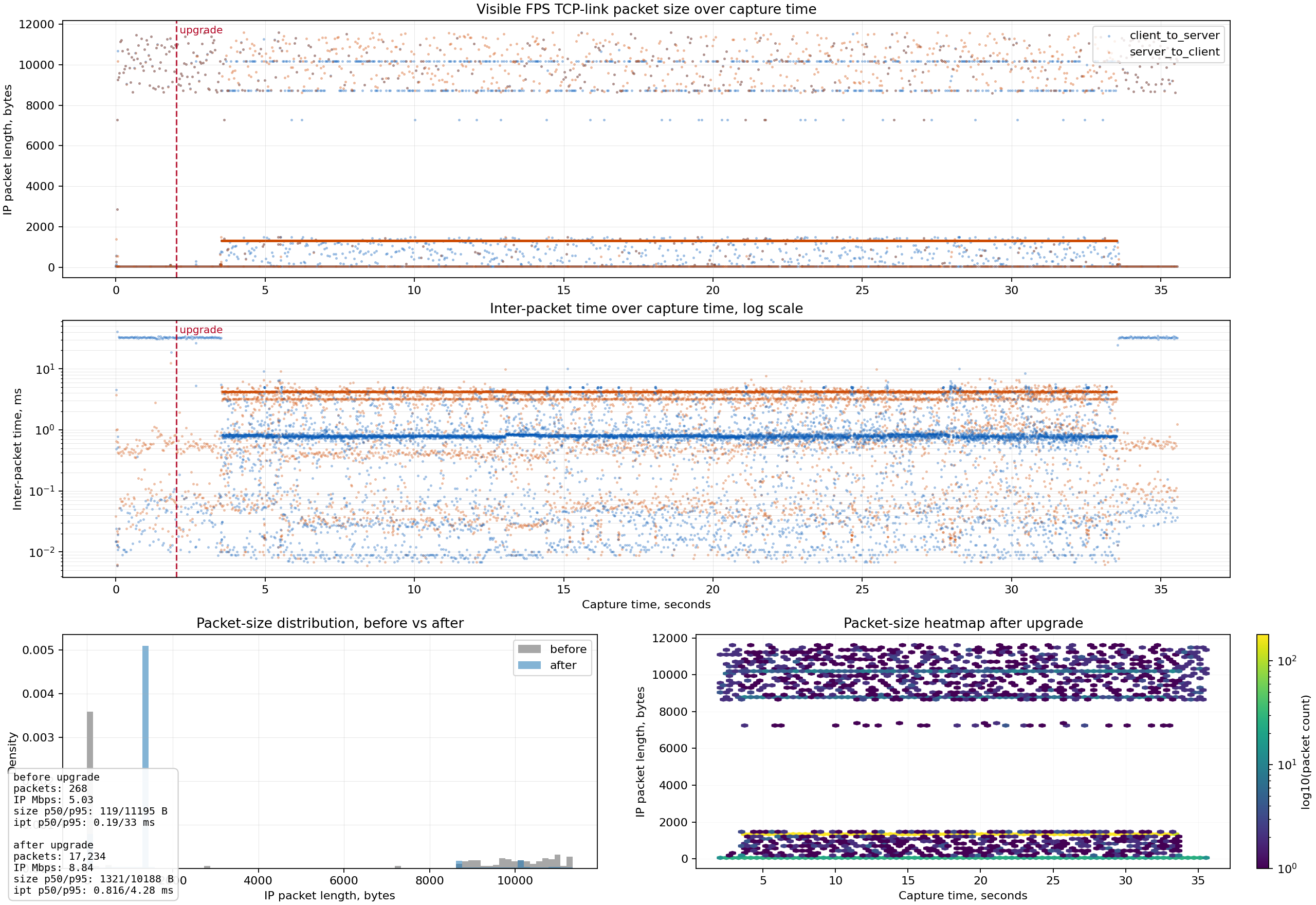
| before upgrade | about 2.02 s | 268 | about 5.03 Mbit/s | 119 B | 11195 B | 0.19 ms | 33 ms |
| after upgrade | about 33.50 s | 17234 | about 8.84 Mbit/s | 1321 B | 10188 B | 0.82 ms | 4.28 ms |
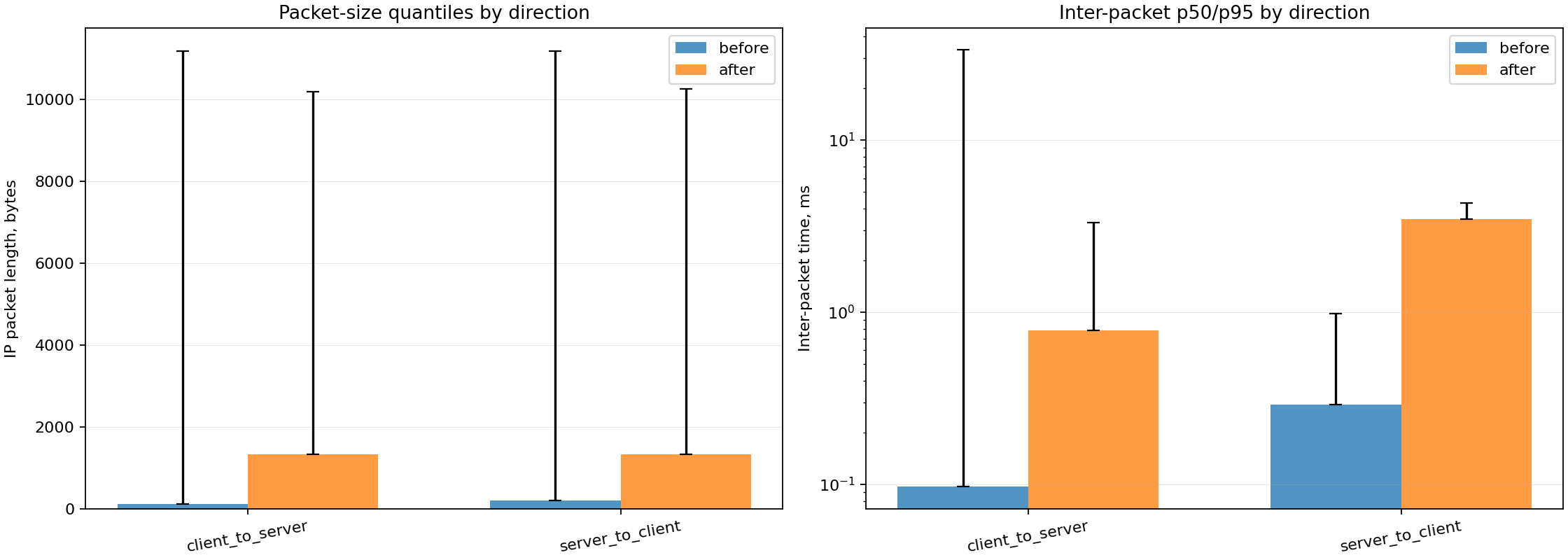
After upgrade, both TCP directions carried roughly 4.4 Mbit/s of visible IP traffic. The median packet size in both directions moved to approximately 1321 bytes, while the upper tail still contained large WSS/TLS records around 9-11 KiB.
Interpretation
The current implementation preserves TLS record syntax: Wireshark and the libpcap checker can still parse the FPS link as TLS. However, the packet-size and timing distributions visibly change after FPS starts carrying TUN traffic.
The strongest signal in this experiment is not an FPS plaintext marker or a broken TLS record boundary. It is a traffic-shape signal:
- a new dense band of near-MTU packets appears after upgrade;
- inter-packet timing becomes much more frequent than the pre-upgrade carrier cadence;
- bidirectional TUN load makes this effect visible in both directions.
This is expected for the current beta. FPS currently prioritizes correctness, lease enforcement, classified-record confidentiality and Docker-first operability over traffic-shape mimicry.
Engineering Conclusion
The next traffic-analysis work should focus on classified-record scheduling and shaping, not on TLS record syntactic validity alone. The first shaper increment now pads inserted classified FPS records to planner-selected full TLS record wire sizes. The current shaper baseline also trains an adaptive CDF from parsed carrier TLS records across sessions and can bootstrap clients with encrypted server snapshots. This is necessary, but not sufficient, for statistical mimicry. Useful next experiments:
- compare a pure carrier capture against carrier-plus-FPS captures at several TUN rates;
- cap or pace covert datagram frames so they do not create a separate near-MTU packet band;
- evaluate whether adaptive CDF scheduling reduces the near-MTU packet band and cadence shift visible in this baseline capture;
- add a pcap-level check that compares observed post-upgrade record-size and inter-packet distributions against the learned carrier model;
- rerun the same pcap analysis over real browser/application carrier sessions, not only the deterministic debug carrier;
- keep
is_pcap_looks_like_tls.pyas a basic wire-shape regression, but add a separate research workflow for packet-size/timing distributions.
For now, treat these plots as a diagnostic baseline. They show that FPS is syntactically TLS-shaped, but not yet statistically shaped.
Remote Market-Data Carrier Experiment
The next experiment moved away from local Docker loopback and debug WSS traffic.
It used a real remote Linux host for fps_server, captured the public
fps_client <-> fps_server link on the remote host’s Ethernet interface, and
used periodic HTTPS GET requests to a public cryptocurrency exchange market-data
API as the carrier. The exact external service is intentionally not part of the
project documentation; the relevant traffic shape is a small client request
followed by a response of roughly 32 KiB.
Experiment parameters:
fps_serverran on the remote host and listened on TCP port443;fps_clientran locally and connected to that public endpoint;- the capture filter selected only the client public IP and server TCP port
443, excluding the server’s separate outbound connection to the origin; - the market-data poller used one persistent HTTPS connection, one GET about every 0.5 seconds, and 150 total polls;
security.zero_rtt.client_upgrade_delay_mswas set to10000, so the plots have a visible pre-upgrade learning window;security.zero_rtt.client_upgrade_delay_sigma_msshould be set to0when reproducing this experiment so the upgrade split is deterministic;- the shaper used adaptive record-size and inter-record-delay CDF learning with encrypted server-to-client CDF snapshots;
- after upgrade, bounded UDP probes produced opaque FPS datagrams over the TUN adapter.
Readable plots from the refined run:
Wire-shape check:
total TLS records: 1033
client -> server Application Data records: 255
server -> client Application Data records: 774
content types observed: ChangeCipherSpec, Handshake, ApplicationData
tcpdump kernel drops: 0
Carrier workload:
| Metric | Value |
|---|---|
| Capture duration | about 75.1 s |
| Upgrade split | about 10.5 s after capture start |
| Market-data polls | 150 |
| Market-data response bytes | about 4.81 MiB total |
| Captured packets | 4576 |
Visible FPS TCP-link packet statistics:
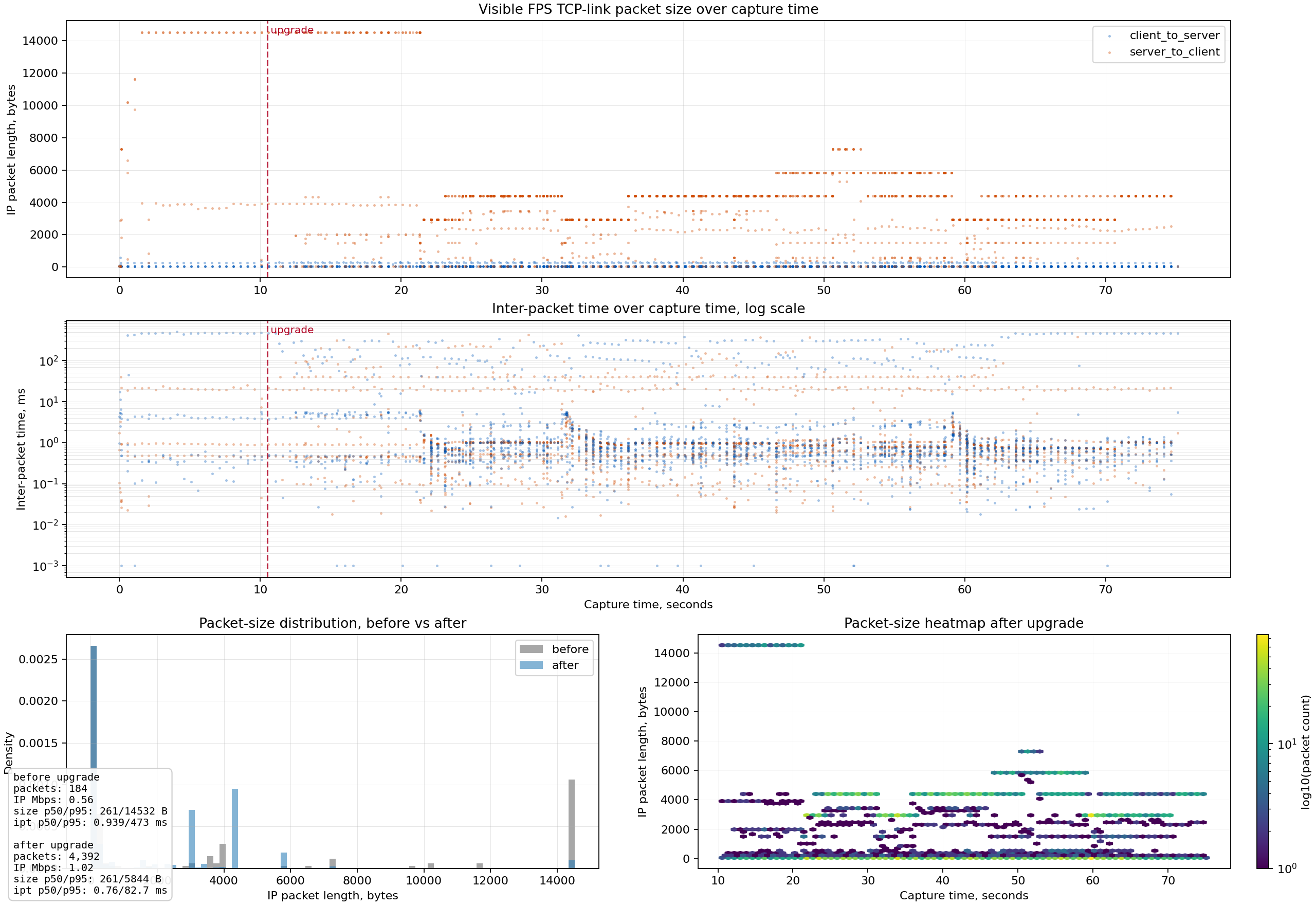
Important capture caveat: these packet-size values come from an endpoint capture
on a virtualized Linux host. Large values such as 8-14 KiB are expected when
GRO/GSO/TSO, checksum offload or hypervisor-side aggregation are active; they
represent coalesced packets as exposed to tcpdump, not Ethernet frames of that
size on the physical wire and not IP fragmentation. The TLS record parser check
below still validates the byte-stream shape, but exact L2/MTU-size conclusions
require capturing after offload is disabled or from an external tap.
| Phase | Duration | Packets | IP throughput | IP size p50 | IP size p95 | inter-packet p50 | inter-packet p95 |
|---|---|---|---|---|---|---|---|
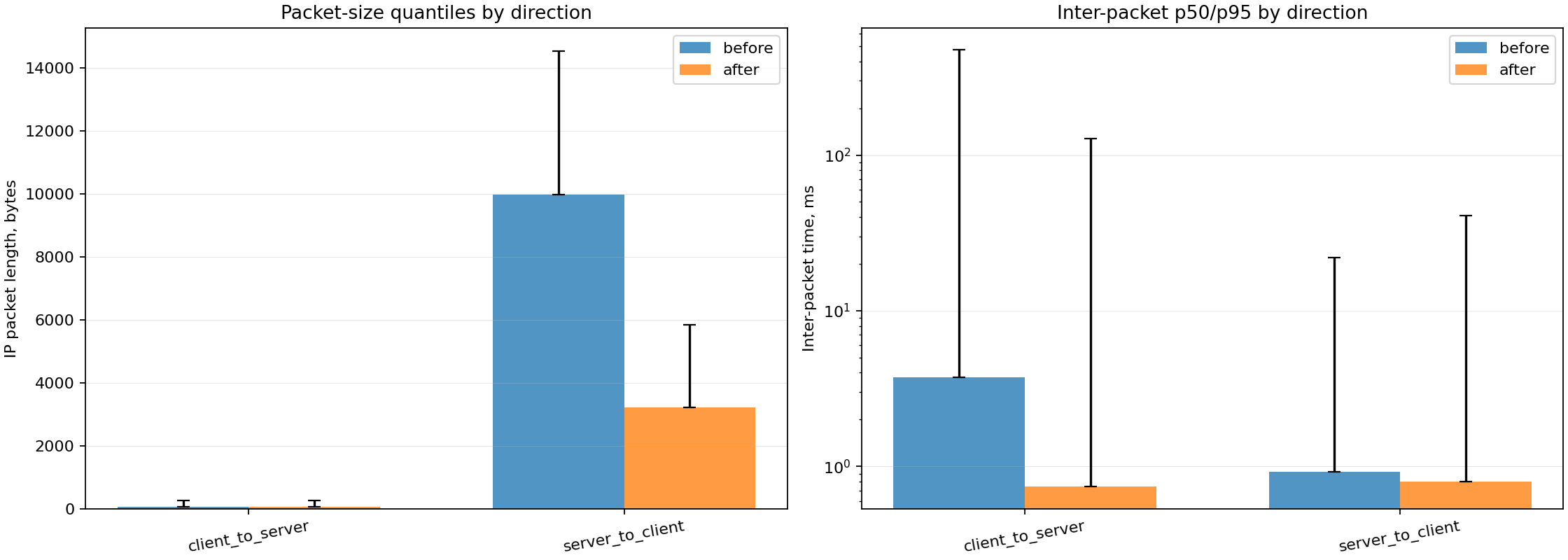
| before upgrade | about 10.1 s | 184 | about 0.56 Mbit/s | 261 B | 14532 B | 0.94 ms | 473 ms |
| after upgrade | about 64.5 s | 4392 | about 1.02 Mbit/s | 261 B | 5844 B | 0.76 ms | 82.7 ms |
Direction-specific post-upgrade statistics:
| Direction | Packets | IP throughput | IP size p50 | IP size p95 | TCP payload p50 | TCP payload p95 |
|---|---|---|---|---|---|---|
| client to server | 2189 | about 0.021 Mbit/s | 52 B | 261 B | 0 B | 209 B |
| server to client | 2203 | about 1.00 Mbit/s | 3212 B | 5844 B | 3160 B | 5792 B |
FPS/TUN signal from daemon counters:
| Direction | Probe | FPS daemon result |
|---|---|---|
| client to server | small UDP datagrams | 103 datagram frames, 6144 bytes accepted by the server-side FPS session |
| server to client | 240 UDP datagrams, 1200-byte payloads | 240 datagram frames, 294720 bytes delivered to the client-side FPS session |
An earlier diagnostic run attempted 256-byte client-to-server UDP payloads before the shaper-aware fragmentation pass. The adaptive shaper learned that this carrier’s client-to-server TLS records were small request records; it therefore kept the oversized covert payload queued instead of emitting a larger, easier-to-fingerprint client-to-server TLS record. That was the correct security-biased behavior for the baseline shaper, but it also showed why FPS datagram fragmentation belongs directly in the shaped send path: if the next datagram is too large for the sampled TLS record, FPS should split it into smaller opaque datagram fragments; if the fragment is smaller than the sampled record, the classified-record codec can fill the remainder with encrypted padding.
The refined run used smaller client-to-server UDP payloads so FPS could insert classified records in both directions. The ad-hoc UDP socket bound to the server’s own TUN address did not receive those local packets, so this experiment does not claim an application-level client-to-server UDP throughput number. The daemon counters are still useful for the pcap question: FPS did encode, send, classify and accept client-to-server datagram frames without breaking TLS record syntax.
Offload-Controlled Remote Repeat
The same remote-host experiment was repeated with endpoint offload effects
explicitly reduced on the capture host. Before starting tcpdump, the remote
Ethernet interface was changed from:
tcp-segmentation-offload: on
generic-segmentation-offload: on
generic-receive-offload: on
rx-gro-hw: on
to:
tcp-segmentation-offload: off
generic-segmentation-offload: off
generic-receive-offload: off
rx-gro-hw: off
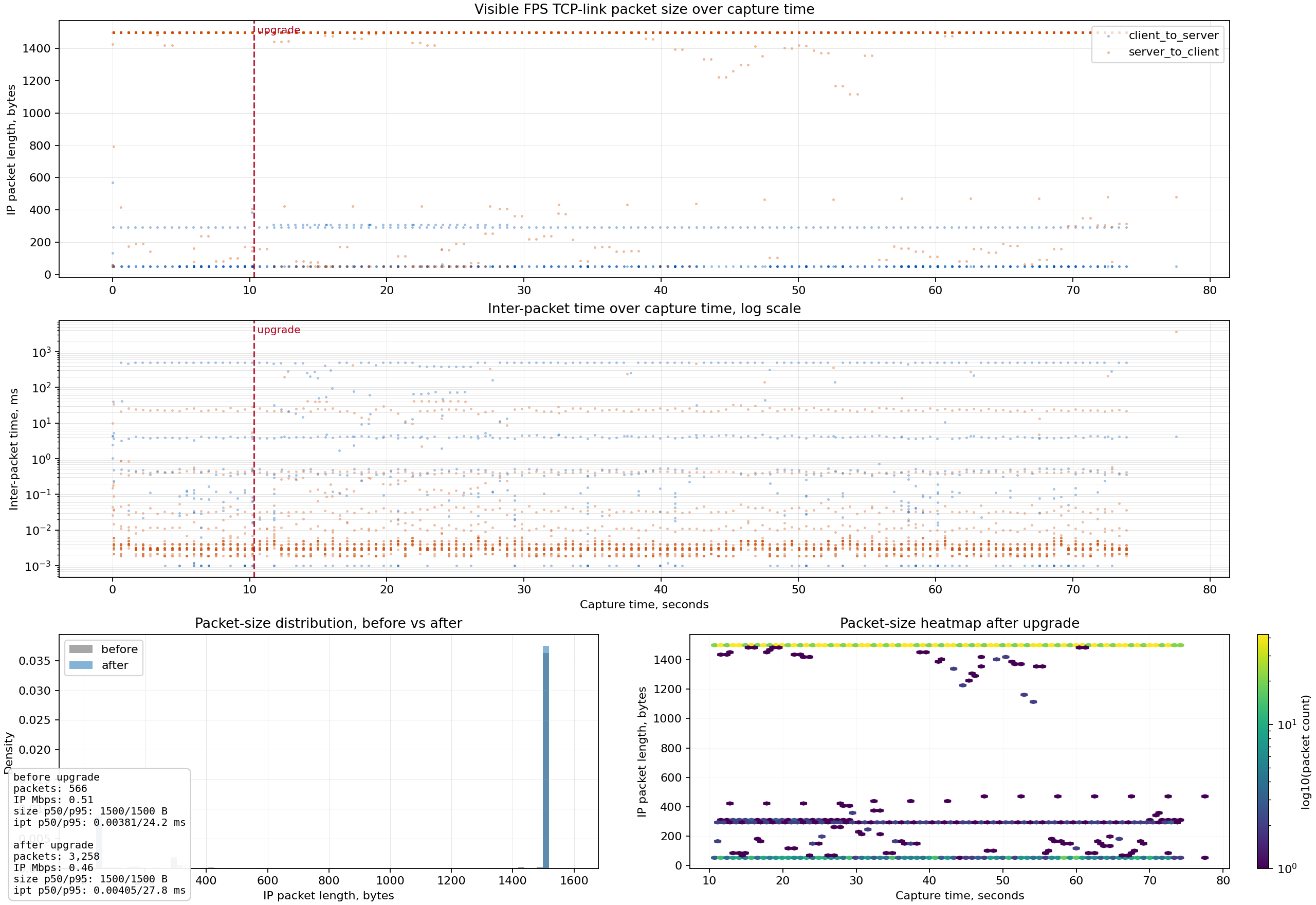
The original settings were restored after the capture. This is still an endpoint capture inside a virtualized environment, not an external tap, but it removes the impossible 8-14 KiB endpoint packet artifacts seen in the earlier run. In this repeat, all observed IP packets were at or below 1500 bytes.
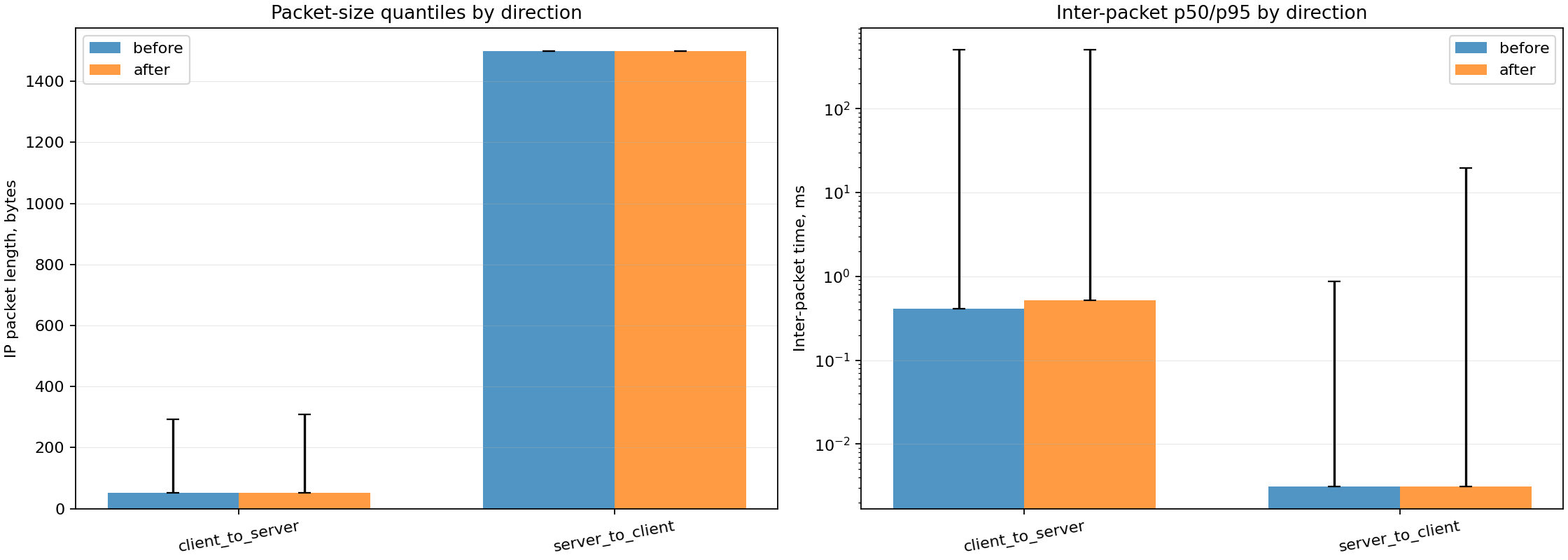
Readable plots from the offload-controlled run:
Experiment parameters:
fps_serverran on the remote host, in host networking, on TCP port443;fps_clientran locally and connected to that public endpoint;- capture filter: client public IP plus server TCP port
443, excluding the server’s separate outbound connection to the origin; - one persistent HTTPS market-data carrier connection, one GET about every 0.5 seconds, 140 successful polls and about 4.17 MiB of response body;
security.zero_rtt.client_upgrade_delay_ms=10000andsecurity.zero_rtt.client_upgrade_delay_sigma_ms=0;- after upgrade, bounded UDP probes generated opaque TUN datagrams in both directions: small client-to-server probes and denser server-to-client probes.
Wire-shape check:
total TLS records: 682
client -> server Application Data records: 177
server -> client Application Data records: 501
content types observed: ChangeCipherSpec, Handshake, ApplicationData
Visible FPS TCP-link packet statistics:
| Phase | Duration | Packets | IP throughput | IP size max | IP size p50 | IP size p95 | inter-packet p50 | inter-packet p95 |
|---|---|---|---|---|---|---|---|---|
| before upgrade | about 10.2 s | 566 | about 0.51 Mbit/s | 1500 B | 1500 B | 1500 B | 0.004 ms | 24.2 ms |
| after upgrade | about 66.8 s | 3258 | about 0.46 Mbit/s | 1500 B | 1500 B | 1500 B | 0.004 ms | 27.8 ms |
Direction-specific post-upgrade statistics:
| Direction | Packets | IP throughput | IP size p50 | IP size p95 | TCP payload p50 | TCP payload p95 |
|---|---|---|---|---|---|---|
| client to server | 600 | about 0.008 Mbit/s | 52 B | 308 B | 0 B | 256 B |
| server to client | 2658 | about 0.45 Mbit/s | 1500 B | 1500 B | 1448 B | 1448 B |
The offload-controlled capture confirms the earlier interpretation with a cleaner packet-size view. The response-heavy carrier naturally produces many MTU-sized server-to-client packets, while the client-to-server direction remains sparse and request-sized. FPS preserved parseable TLS record syntax after upgrade and did not create endpoint-captured packets larger than the interface MTU once GRO/GSO/TSO effects were disabled.
The very small inter-packet medians should not be overinterpreted as physical
wire timing. They are endpoint tcpdump timestamps for bursts of already
segmented packets in a virtualized environment. They are useful for regression
comparison between runs on the same host, but final mimicry claims still require
an external capture point or a controlled bare-metal capture setup.
Remote-Carrier Interpretation
This capture is closer to a real automated carrier than the local WSS debug baseline. It shows three practical points:
- the link remains syntactically TLS-shaped after upgrade;
- the adaptive shaper respects directional carrier asymmetry instead of forcing large records into the thin client-to-server request stream;
- a dense response-heavy HTTPS polling carrier can provide useful server-to-client covert capacity, but it is not a balanced full-duplex carrier unless the application naturally sends larger client-to-server records too.
The next useful research step is to repeat the same measurement with carriers whose application protocol is naturally full-duplex or client-upload-heavy, then compare post-upgrade CDF drift against the carrier-only baseline.
For repeatable follow-up runs, a live adaptive profile can be exported from a
running daemon with fps_client --write-shaper-profile --config client.json
--output profile.json or the equivalent fps_server command. The exported JSON
uses compact CDF pairs and can be used as a static bootstrap profile for later
captures without replaying the original training window.
When FPS has not been deployed yet, a baseline can also be prepared offline from a carrier-only pcap:
python3 tools/pcap_to_shaper_profile.py carrier-baseline.pcap \
  --port 443 \
  --profile-id example-origin-v1 \
  --output profile.json
This uses TCP reassembly and TLS record parsing rather than packet boundaries. It therefore remains valid when the pcap contains fragmented or coalesced TCP segments, as long as the selected TCP stream is complete enough to parse TLS records.
For future shaper experiments, treat Docker bridge and VM endpoint captures as operational diagnostics rather than final wire evidence. They can validate TLS record syntax and shaper behavior at the byte-stream level, but physical packet size claims require an external capture point or an endpoint measurement with offload effects explicitly controlled.